
AI Website Agent
Automate website and business authenticity checks
The AiPrise Website Review Agent helps compliance and risk teams automatically review a business’s website and broader online presence. It verifies authenticity, detects missing legal content, and identifies potential risks — enabling instant, policy-based onboarding decisions.
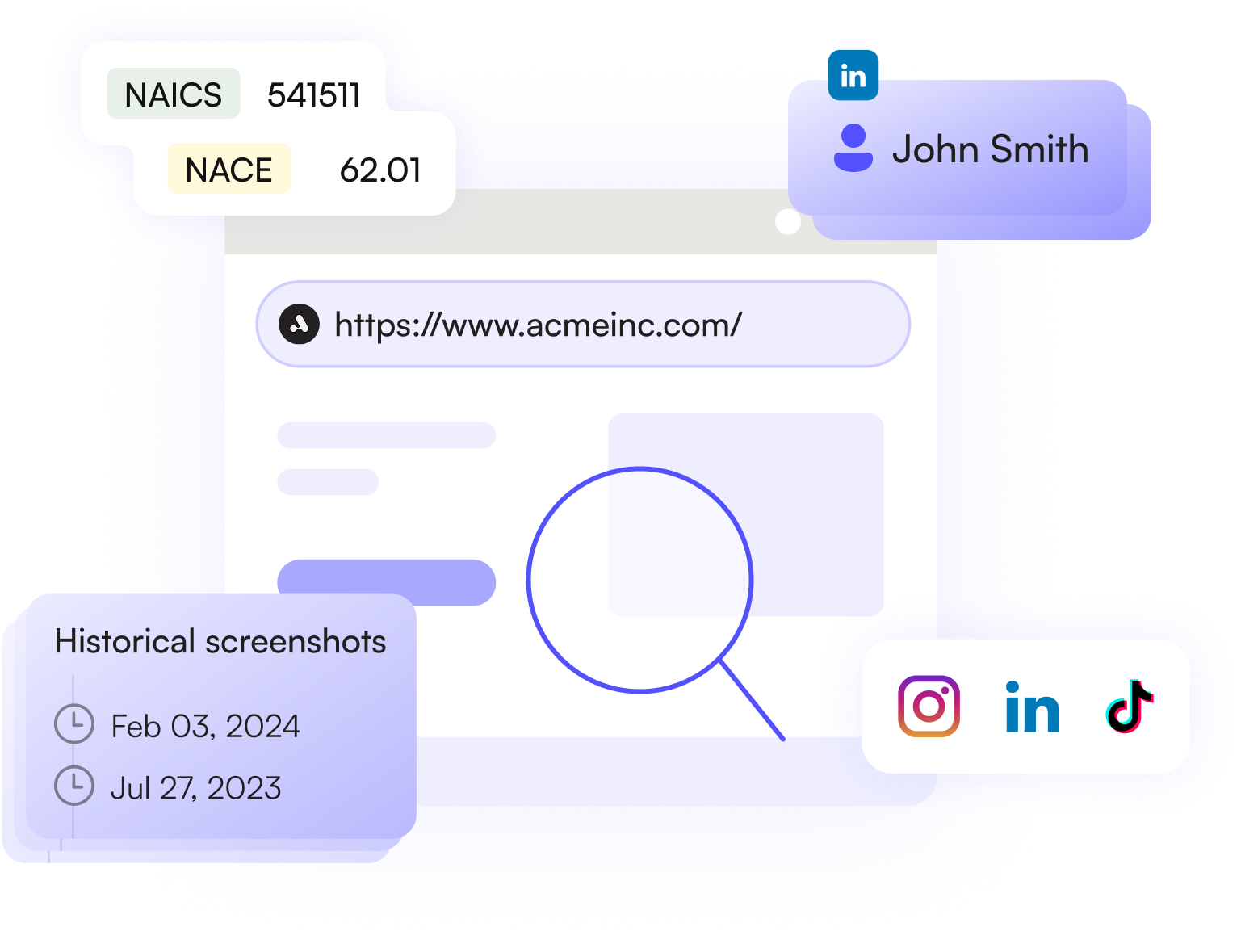
Product Overview
When businesses apply for onboarding, verifying their legitimacy can be time-consuming. Many fraud risks or compliance issues show up in how a company presents itself online — missing legal pages, mismatched contact details, or cloned websites.
The Website Review Agent automates this due diligence. It analyzes a company’s domain, web content, and digital footprint to provide an authenticity report and automated decision (Approve, Review, or Reject) based on your organization’s risk policies.
How It Works
Input a Website URL You submit a company’s website (e.g., https://company.com).
Domain Normalization The system automatically reduces the URL to the registered root domain.
Example: https://www.company.com/some/blog → company.com
Automated Web Presence Review The agent scans the domain’s index page and associated online profiles to build a complete web presence snapshot.
Scoring and Decision AiPrise evaluates multiple signals — authenticity, contact consistency, legal compliance, and digital reputation — and returns a structured result with a confidence-based decision.
What the Agent Reviews
Each review includes detailed sections to help your team understand the findings and reasoning behind the decision.
- Website Information
- Domain and Title: Extracts the business name and verifies ownership.
- Legal Pages: Detects Terms & Conditions, Privacy Policy, and other compliance pages.
- Authenticity Flag: Highlights if the website content appears genuine or templated.
- Profile
- Business Summary: AI-generated description of the business.
- Company Details: Founding year, size, and revenue (if available).
- Trust Indicators: Checks for consistency between claims and public data.
- Contact Details
- Email, Phone, Address: Extracted from the site and verified.
- Map Integration: Displays the location and validates existence.
- Cross-Check: Matches against known business directories.
- Industry Classification
- Categorizes the business using NAICS, MCC, and SIC codes.
- Helps confirm if the website’s services align with claimed industry activities.
- Website & Domain Analysis
- Registrar Details: Confirms registration date, registrar, and SSL validity.
- Hosting Provider: Checks whether the site is hosted by a reputable provider (e.g., Cloudflare, AWS).
- Domain Age: New domains trigger higher scrutiny (e.g., registered < 6 months).
- Webserver & Technical Health
- Tests responsiveness, SSL setup, and security features like robots.txt.
- Detects parked or inactive domains.
- Social Media & Reputation
- Identifies linked Facebook, Instagram, LinkedIn, or X accounts.
- Reviews average ratings and presence across online review sites.
- Flags any adverse media mentions or reputation issues.
- Traffic & Engagement
- Provides visibility metrics where available (visits, keywords, backlinks).
- Helps assess how active and legitimate the website is.
- External Trust Signals
- Cross-references third-party reputation sources (e.g., ScamAdvisor) for a normalized trust score and blacklist or anti-phishing context.
- Marketplace Information
- Identifies businesses operating as marketplaces and flags fraudulent marketplace patterns.
- Detects fake reviews, fake seller indicators, generic product content, incoherent catalogs, unrealistic pricing, and urgency-manipulation tactics.
- Payment Flow
- Detects payment forms, checkout flows, and product listings on the website.
- Lists detected payment providers and flags sites that accept only irreversible payment methods (crypto, wire, gift cards).
- Network Intelligence
- Surfaces related domains that share critical infrastructure - shared templates, copied content, reverse-image matches, certificates, and hosting patterns.
- Helps detect whether a site is part of a broader fraud network rather than a one-off, with a connected-domain map and a customer-readable summary.
- Risk Indicators
- Surfaces severity-rated flags (low, medium, high) such as unverifiable contact information, fake or dead social links, young domains with commercial intent, irreversible-payments-only, high claims with no traffic, and marketplace risk.
- Each indicator is explainable, with a short detail and supporting evidence.
- Field Evidence
- Every field populated by AI check comes with supporting evidence - the reasoning behind the value, a confidence level, and citations to the source pages (if available) - for a defensible audit trail.
Automated Decisioning
Based on the findings, AiPrise classifies each website as:
| Decision | Description |
|---|---|
| Approved | Website authentic, consistent, and compliant. |
| Review | Minor concerns (e.g., missing legal pages or new domain). Manual check recommended. |
| Rejected | Major authenticity, content, or domain-related red flags detected. |
Your team can configure custom rules and thresholds aligned with your internal onboarding policy.
Continuous Monitoring
The Website Agent can also run in monitoring mode, automatically re-evaluating onboarded businesses' websites on a recurring cadence. When a meaningful change is detected against the previous snapshot — new or removed legal pages, contact info changes, social profile updates, domain changes, etc. — AiPrise delivers a webhook event to the business profile's events_callback_url with the updated website section and a structured diff describing what changed.
See Website Monitoring for the full event payload, delivery behavior, and field reference.
Updated 4 months ago