
Template Types and Tags
AiPrise supports both User (KYC) and Business (KYB) templates. Each template contains tags that represent the types of verification checks included in that template—such as ID verification, face match, business lookup, AML screening, risk scoring, fraud checks, and more. These tags act as descriptors to help you quickly identify what the template does and which checks it will perform during a verification.
Types of Templates
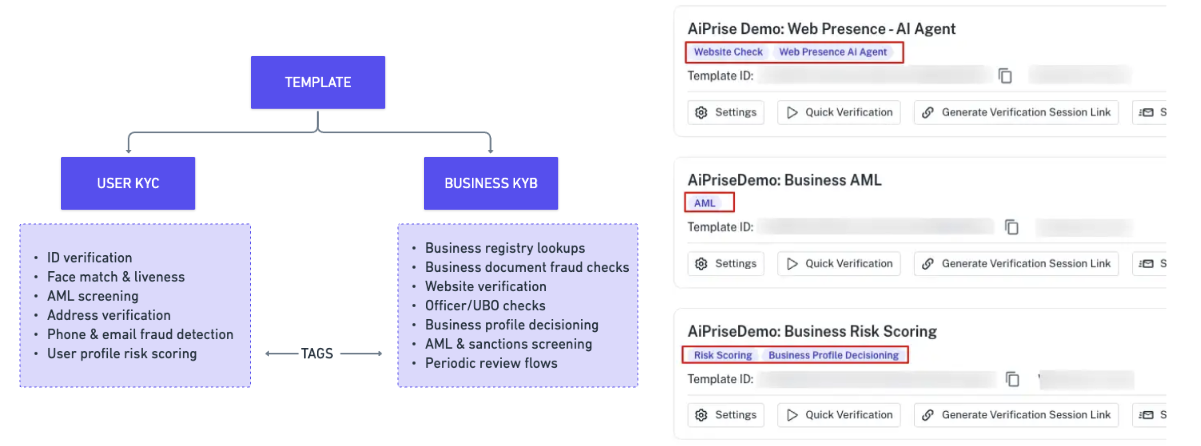
Template Tags
Each template includes one or more template tags.
Template tags describe the types of checks, modules, and logic blocks that the template uses.
They help you (and your team) quickly understand what a template does without opening every individual configuration.
Think of template tags as labels that define the verification scope and capabilities of the template.
Expand the below view to know have a detailed view of all the Template tags
Common Tags & their Meaning
- Document Fraud Check: Detects fake, altered, or tampered identity or business documents using AI-based fraud analysis.
- Business Document Fraud Check: Validates authenticity of business-related documents (certificates, incorporation docs, licences, etc.).
- AML: Performs AML & sanctions screening using global watchlists, PEP lists, enforcement lists, and adverse media.
- Business Lookup: Fetches and verifies company information from government registries and global databases.
- ID Verification: Extracts and validates identity document data (passport, national ID, driver license, etc.).
- Face Match: Compares the face from the selfie with the photo on the uploaded identity document.
- Face Liveness: Ensures the applicant is a real person performing the verification (not a deepfake, printout, or replay attack).
- Website Check: Validates whether the business website exists, is reachable, and matches submitted business details.
- Address Verification: Verifies applicant’s address using document-based proof (e.g., utility bill) or data sources.
- Phone Email Fraud Check: Runs fraud scoring based on phone number and email patterns, reputation, and risk databases.
- Business Profile Decisioning: Runs decision logic on business profiles, including officer/UBO evaluation and registry comparisons.
- Risk Scoring: Combines signals from multiple checks to produce a risk score (low, medium, high).
- User Profile Risk Scoring: Creates a risk score for users based on identity, behavior, device, geo-risk, and fraud metadata.
- Document Insights AI Agent: AI-driven analysis providing deeper insights into document structure, anomalies, and metadata.
- Follow Up Session: Allows re-verification or additional document steps after the initial verification session.
- Dynamic: Template dynamically adjusts steps based on region, risk, document type, or previous results.
- User Profile Decisioning: Decision engine applied to user profiles to determine pass / fail / manual review outcomes.
- Web Presence AI Agent: AI-driven check that evaluates an individual’s or business’s web presence, legitimacy, and signals.
- Periodic Review: Used for scheduled re-verification of businesses (e.g., every 6–12 months for compliance).
Updated 2 months ago